
Psoriasis is chronic.
It's also treatable.
Psoriasis develops when the immune system sends faulty signals telling skin cells to grow too quickly, in days rather than weeks. It may look contagious, but it isn't.
An immune-driven disease you inherit, not one you catch.
Psoriasis (sore-EYE-ah-sis) is a chronic, long-lasting disease. It develops when a person's immune system sends faulty signals that tell skin cells to grow too quickly, new skin cells form in days rather than weeks.
The body does not shed these excess skin cells. They pile up on the surface of the skin, causing patches of psoriasis to appear.
Psoriasis may look contagious, but it's not. You cannot get psoriasis from touching someone who has it. To get psoriasis, a person must inherit the genes that cause it.
Five types, and some people get more than one.
What you see and feel depends on the type of psoriasis you have. Sometimes a person gets one type, and then the type changes.
Plaque
Raised, reddish patches covered with a silvery-white coating, most often on the knees, elbows, lower back and scalp. Patches can itch, and scratching thickens them. Nail pitting and crumbling are common.
Guttate
Small red spots, usually on the trunk, arms and legs, but they can appear on the scalp, face and ears. Spots often follow an illness such as strep throat and may clear in weeks or months without treatment.
Inverse
Also called flexural or intertriginous psoriasis. Smooth, red patches of skin that look raw, developing only where skin touches skin, armpits, groin, genitals, buttocks and under the breasts. The skin feels very sore.
Pustular
Red, swollen skin dotted with pus-filled bumps, usually on the palms and soles, with soreness and pain. Bumps dry and leave behind brown dots or scale. If pus-filled bumps appear all over the body, seek hospital care immediately.
Erythrodermic
Also called exfoliative psoriasis. Most or all of the skin turns bright red and looks burned, with intense itching and pain, and the body cannot maintain normal temperature. This is a medical emergency, go to a hospital right away.
Nail involvement
Pitting of the nails, crumbling nails, or nails that separate and fall off can accompany any type, and is sometimes the first sign a dermatologist notices.
Not sure where to start? Start with a visit.

An arsenal of therapies, matched to your condition.
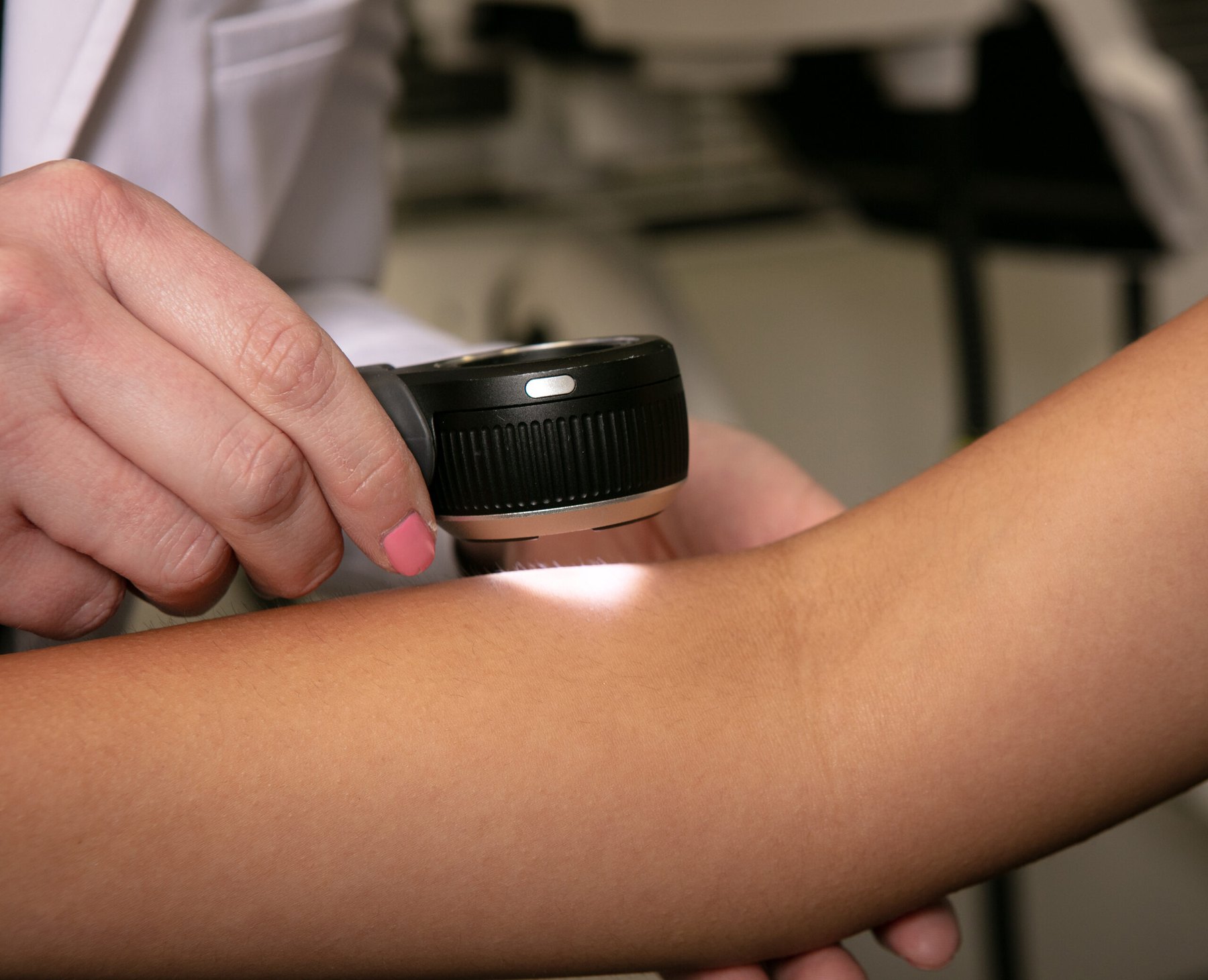
To diagnose psoriasis, a dermatologist examines the skin, nails and scalp for signs of psoriasis, asks whether family members have it, and learns about what has been happening in your life, significant stress, a recent illness, or a newly started medicine. Sometimes a dermatologist also removes a bit of skin to confirm the diagnosis under a microscope.
Treating psoriasis has real benefits. Treatment can reduce signs and symptoms, which usually makes a person feel better. With treatment, some people see their skin completely clear, and treatment can meaningfully improve quality of life.
Our providers have an arsenal of ways to treat psoriasis and will analyze your unique condition to determine the best treatment for you.
Examine
Skin, nails and scalp are checked for the signs characteristic of each type.
History
Family history, recent illness, stress and new medications are all reviewed.
Confirm
If needed, a small skin sample is examined under a microscope.
Treat
A plan drawn from topical, light-based and systemic options for your specific type.
What to watch for, and when it becomes urgent.
Everyday signs
- Raised, reddish patches covered with silvery-white scale.
- Patches on the knees, elbows, lower back and scalp that can itch.
- Patches that vary in size and can join together to cover a large area.
- Nail problems, pitting, crumbling, or a nail that falls off.
What sets it off
- Recent illness, especially strep throat, can bring on guttate spots.
- Periods of significant stress.
- Certain newly started medications.
- Skin injury, sunburn or friction in skin folds.
Seek care immediately
- Pus-filled bumps appearing all over the body.
- Bright-red skin over most of the body, as if badly burned.
- Fever, chills, rapid pulse, exhaustion or muscle weakness.
- Intense itching and pain with an inability to stay warm or cool.
If it looks like a person has erythrodermic or widespread pustular psoriasis, get them to a hospital right away, their life may be in danger.
Answers are one call or one visit away.
Take an active role in managing the disease.
Psoriasis is a chronic disease of the immune system. It cannot be cured, which means most people have psoriasis for life. By teaming up with a dermatologist who treats psoriasis, you can find a treatment plan that works for you.
Dermatologists encourage patients with psoriasis to take an active role in managing the disease. By doing so, you can reduce the effects psoriasis has on your quality of life.
Medical Dermatology
Board-certified dermatologists treating the full range of skin, hair and nail conditions across seven Hampton Roads locations.
View all medical servicesSchedule with the practice Hampton Roads has trusted since 1946.
Book an appointment with one of our providers and start your journey to healing today. Call (757) 622-6315 or request an appointment online.
Wherever you are in Hampton Roads, we're close.
From Norfolk to Williamsburg, seven offices, each staffed with board-certified dermatologists and supported by an in-house dermatopathology lab.
Schedule with the practice generations of Hampton Roads families have trusted since 1946.
Book online in under a minute, or call the office nearest you. New patients welcome.